Pavement Politics: How Your Street Layout Writes Your Step Count
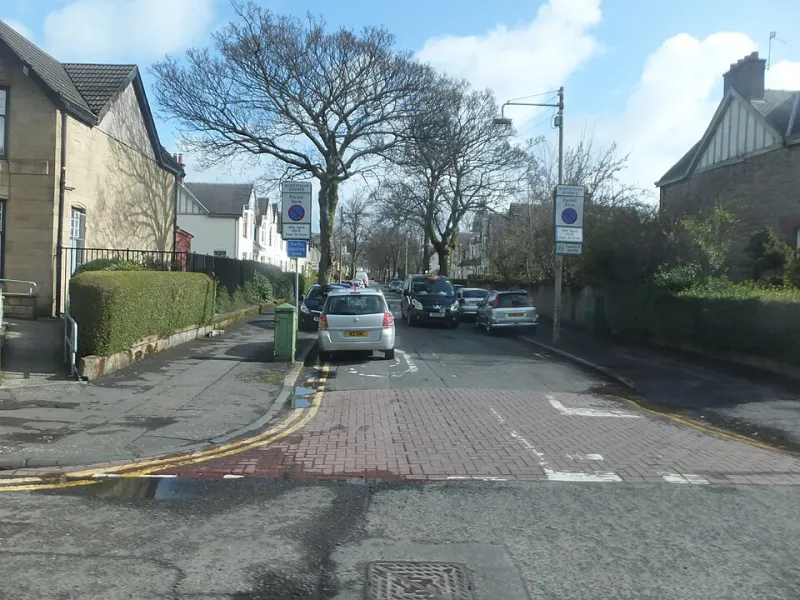
Photo: Barbara Carr , CC BY-SA 2.0, via Wikimedia Commons
Walk for thirty minutes in two different UK postcodes and your pedometer can tell two different stories. One route might rack up 3,800 steps on a flat grid of terraced streets; another might land nearer 2,900 because a ring road, a steep hill and two long waits at pelican crossings ate the distance. That is the postcode step gap in everyday clothes: not a moral failing, not a lack of willpower, just the built environment quietly setting the terms.
In 2026, with more of us comparing step counts through apps, workplace challenges and smartwatch streaks, it is tempting to treat 10,000 as a universal target. But a target only makes sense when it meets the street you walk down. A cul-de-sac estate with no corner shop and a busy dual carriageway at the edge is playing a different game from a dense town centre with wide pavements and frequent crossings.
The street layout is the first filter
Grid streets, cul-de-sacs, gated estates and retail parks all change how far you have to walk to do ordinary things. A permeable grid gives you choices: turn left, cut through, take the quieter road. A cul-de-sac layout can be peaceful, but it often funnels every journey onto the same spine road. That matters for step counts because walking is easier to accumulate when it is woven into the day rather than treated as a separate event.
Look at your own neighbourhood with a cold eye. Is there a direct pavement route to the shop, the school, the bus stop or the park? Or does the walking route take you around the edge of a housing estate while the car route goes straight through? Pedometers do not care about intention. They count the path you can actually take.
Pavements, crossings and the small tax on walking
Pavement quality is the quiet background character in every step count. Narrow pavements with parked cars force you into the road. Uneven slabs make you look down rather than ahead. Overgrown hedges turn a two-metre pavement into a single-file squeeze. None of these things stops a walk, but they add friction, and friction changes behaviour over a week.
Crossings are just as important. A 30-second wait at four crossings is two minutes of standing still. A crossing that feels unsafe at dusk can rule out an evening walk entirely. The step gap is not only about distance; it is about how pleasant and predictable the route feels. A pedestrian island, a dropped kerb and a well-timed green man are small pieces of infrastructure that make a big difference to whether you bother.
Hills and amenities change the meaning of a step
Hills are one of the fairest things to notice. A hilly route may produce fewer steps than a flat one in the same time, but it asks more of your legs and lungs. If you live in a valley town or on the edge of the Pennines, a 7,000-step day may represent more effort than a flat 10,000-step day. That does not make one better than the other. It just means the number needs context.
Amenities matter too. A postbox two streets away is a different proposition from a postbox two miles away. A corner shop, a school, a GP surgery, a park and a bus stop within a short walk create natural reasons to move. A retail park with wide roads and no pavement between units creates reasons to drive. Your pedometer records the result, not the planning decision behind it.
A one-week walkability audit with your pedometer
You do not need a clipboard and a high-vis jacket to audit your patch. Pick three regular journeys: perhaps the shop, the school run or a loop around the block. Walk each one twice in the same week, ideally at a similar time of day. Record your steps, time, the main barriers and how safe you felt. A simple note on your phone is enough.
Try a basic scoring system out of five for pavement quality, crossing ease, lighting, traffic noise and hilliness. Then add a line for the main friction: parked cars, a missing dropped kerb, a long wait at a junction, a dark alley, a muddy shortcut. The aim is not to produce a council report. It is to see which routes are doing the heavy lifting and which ones are quietly putting you off.
| Route | Steps | Time | Main friction |
|---|---|---|---|
| Shop and back | 2,100 | 24 min | Two crossings, narrow pavement |
| Park loop | 3,400 | 38 min | Hill on return leg |
| School run | 1,600 | 18 min | Parked cars near gate |
By the end of the week you will have a local baseline. That is more useful than a national average because it belongs to your streets, your knees and your timetable.
Adapt your step goal to the place you actually live
Start with your own baseline week rather than an idealised version of your life. If your normal week lands around 5,500 steps, a sudden 10,000 target may be less a challenge and more a route to frustration. Add a modest amount instead: 500 steps a day, or one extra short loop three times a week.
Use time-based goals when your route is hilly or stop-start. A 20-minute walk is a 20-minute walk even if the step count varies. Use route-based goals when your environment is predictable: the park loop, the shop-and-back, the school run extended by one street. And give yourself permission to treat rainy, dark or icy days differently. The best step goal is the one you can repeat in the place you actually live, not the one that looks good in a generic app.
None of this is about lowering ambition. It is about aiming at the right target. Your postcode is part of your walking challenge, whether you like it or not. A pedometer can help you see that clearly, one ordinary street at a time.