Two Minutes Before the Tea: A Very British Walking Habit
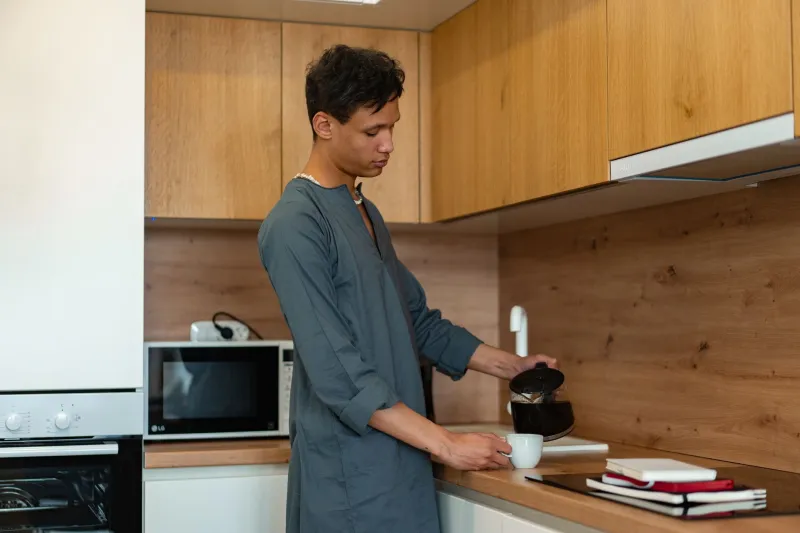
Tea breaks are one of the few parts of the British day that arrive without being booked. The kettle goes on, the kitchen becomes a waiting room, and most of us spend two or three minutes watching water heat up. That is not a personal failing. It is simply a gap. The idea here is to fill part of that gap with a short walk — not a workout, not a dash to 10,000 steps, just a small loop that your pedometer can record honestly.
Why the kettle is a better trigger than a Monday morning plan
Most walking plans fail because they rely on a decision at a vague moment. 'I'll walk more' is not a trigger. 'When the kettle goes on' is. Behaviour scientists call this habit stacking: attaching a new action to something that already happens reliably. In the UK, the kettle is about as reliable as it gets. It runs through home working, office kitchens, awkward family visits and wet Sunday afternoons.
The other advantage is size. A two-to-five-minute walk is small enough that it doesn't need gym kit, a shower or a gap in the calendar. You can do it in jeans, in a hallway, or around the block while the kettle cools. Small is not the same as pointless. If you make tea four times a day and walk for three minutes each time, that is twelve minutes of extra movement you did not have before. Over a week, that is more than an hour.
What counts as a kettle walk (and what doesn’t)
The honest answer is: walking counts if you are actually walking. Standing by the counter and shifting your weight does not. Shaking your pedometer to make the number move definitely does not. A kettle walk is simple. Put the kettle on, leave the kitchen, walk at an easy pace for two to five minutes, come back before the tea stews. If you use a pedometer, start counting when you leave the kitchen and stop when you return. Write down the number or let the device store it, but don't round it up in your head.
At home, that might be a lap of the hallway, a trip up and down the stairs, or a circuit of the garden. In a flat, it might be pacing the living room while the radio plays. At work, it could be a loop to the printer and back, a walk to the far corridor, or a lap of the car park. The only rule is that the walk has to be real enough that you would count it for someone else.
Home, office, and the classic wet Tuesday
The home version is the easiest to start because the kettle is yours. Keep a pair of comfortable shoes by the door or simply walk in socks on carpet. If stairs are part of the route, use them at a steady pace rather than treating them as a race. The point is consistency, not sweat.
The office version needs a little more thought. Office kitchens are social spaces, and disappearing every time someone fills the kettle can look odd. A better approach is to make the kettle walk a shared option. 'I'm doing a quick loop while it boils' is a normal sentence. If the kitchen is busy, walk the long way back to your desk. If you are on a video call, wait. The habit should fit the day, not fight it.
Wet weather is where most British walking habits go to die. The answer is not to pretend a downpour is pleasant. It is to have an indoor route ready before the rain starts. A hallway, a landing, a covered walkway, a shopping centre if you are nearby, or a few laps of a dry room all count. If you use a step tracker, keep it on your waist or in a pocket and walk normally. Do not march on the spot in front of the telly and call it a kettle walk unless you genuinely walked. Honesty matters more than the number.
A one-week experiment: tea, walk, note, repeat
Try this for seven days. You do not need a new app or a training plan. You need a kettle and a note on your phone.
Day one: just count your normal tea breaks and note your step total at the end of the day. Do not change anything. Days two to seven: every time the kettle goes on, take a two-to-five-minute walk. Keep the walk short enough that you still want to do it on day six. Note the step count for each kettle walk if your pedometer makes that easy, or simply note that it happened. At the end of each day, write down your total steps and one word for how the habit felt: easy, rushed, silly, fine.
At the end of the week, look at two things. First, did the walks actually happen? Second, did your daily step total move without you chasing a target? If the answer to the first is yes, you have a habit. If the answer to the second is not much, that is still useful information. A kettle walk is not a magic step multiplier. It is a way to stop the day being completely still between cups of tea.
The point isn’t the steps
Pedometers are useful because they tell you what you actually did. They are less useful when they turn every cuppa into a scoreboard. The kettle habit works best when it stays slightly boring: kettle on, short walk, tea made, back to the day. If you miss one, make the next one. If you are somewhere without a safe route, skip it. The habit is supposed to make the day feel more mobile, not more managed.
Britain's tea breaks are not going anywhere. Neither, unfortunately, is the rain. But the two or three minutes while the kettle boils are a small, regular opening. Use a couple of them for a walk, log what you honestly did, and let the week decide whether it is worth keeping. No leaderboard required.